.svg)
Understanding facility management platforms
Choosing the right facility management platform for a multi-campus hospital system is one of the most consequential infrastructure decisions healthcare leaders face today. With regulatory scrutiny intensifying and building complexity growing, the margin for operational error is shrinking fast.
Hospital facilities teams are managing more square footage, more compliance requirements, and more stakeholder expectations than ever before. A platform that can't keep pace with BIM integration, mobile workflows, and audit readiness isn't just inconvenient — it's a liability.
The strongest facility platforms don't just track assets; they actively close the gap between physical infrastructure and compliance accountability.
What separates purpose-built hospital solutions from generic alternatives becomes clearest when you examine how each platform is structured at its core — and that starts with understanding exactly what modern facility management platforms are designed to do.
Understanding facility management platforms
A facility management platform is software designed to centralize the planning, maintenance, compliance tracking, and operational oversight of physical assets within a building or campus. For hospital systems, this definition carries considerably more weight. Clinical environments must maintain strict safety standards, manage complex equipment inventories, and coordinate across departments — often simultaneously across multiple locations.
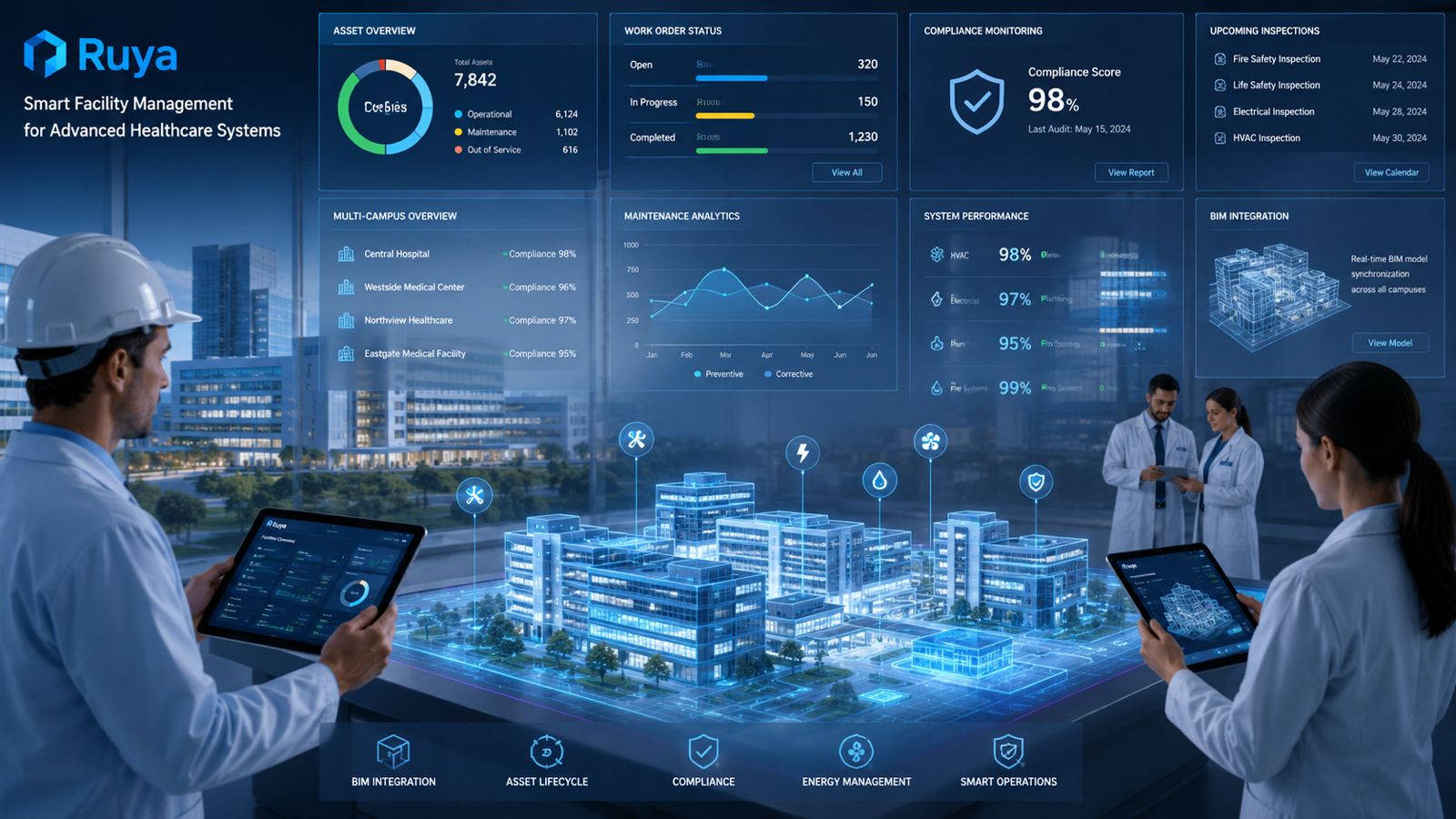
BIM integration has become a defining capability in modern platforms, allowing facility teams to connect real-time operational data directly to 3D building models. According to HFM Magazine, transitioning facility operations to BIM allows teams to visualize assets in spatial context, dramatically reducing response time during maintenance and inspections.
Platforms also differ significantly in how they handle healthcare compliance tracking — a non-negotiable function for any accredited hospital. Understanding these core differences is essential before evaluating any specific tool, particularly for systems managing the compounded complexity of multiple campuses.
The Challenges of Managing hospital systems with Multiple Campuses
Hospital systems operating across multiple campuses face a level of operational complexity that single-facility organizations rarely encounter. Coordinating maintenance schedules, compliance documentation, and asset inventories across geographically dispersed buildings introduces compounding risk at every level.
A common pattern is that facilities teams struggle most with data fragmentation — different campuses running different workflows, using disconnected spreadsheets or siloed software that can't communicate. The result is duplicated effort, missed inspections, and compliance gaps that surface only during audits.
Keeping facilities audit-ready requires unified, real-time visibility across every site — not just the flagship campus.
Standardizing compliance protocols while accommodating each building's unique infrastructure is another persistent challenge. In practice, aging facilities on the same network as newly constructed towers demand entirely different maintenance frameworks.
Understanding how the built environment itself is documented and tracked becomes critical at this scale — which is exactly where BIM integration enters the conversation.
Why BIM integration is Crucial for Hospital Management
Building Information Modeling (BIM) transforms how healthcare facilities plan, operate, and maintain their physical environments. Rather than relying on disconnected floor plans or outdated paper records, BIM provides a dynamic, data-rich model of every structural element, mechanical system, and patient zone across a campus.
For hospital systems managing multiple locations, this matters enormously. As outlined in this overview of hospital facility operations, coordinating maintenance, compliance, and infrastructure across campuses demands a single source of spatial truth — exactly what BIM delivers.
BIM integration enables facility teams to:
- Locate assets precisely within complex building geometries
- Model infection control risk zones during renovations
- Anticipate maintenance needs using real-time system data
"BIM gives healthcare facilities the spatial intelligence to manage complexity before it becomes a crisis."
In practice, disconnected data leads to costly delays and compliance gaps. BIM closes that gap by linking physical space to operational workflows. Knowing which features to prioritize in a platform, however, requires careful evaluation — which the next section addresses directly.
Selecting the Right facility management platform: Key Features to Consider
With the operational complexity and BIM integration requirements covered in earlier sections, the question becomes practical: what specific capabilities should decision-makers prioritize? Effective BIM facility management goes beyond simply importing 3D models — it requires a platform that bridges design data with day-to-day operations across every campus.
Key features to evaluate include:
- BIM model integration — bidirectional data sync between models and work orders
- Asset lifecycle tracking — linking equipment records directly to spatial data
- Multi-campus dashboards — unified visibility across all facilities
- Compliance workflow support — structured processes aligned with Joint Commission Environment of Care standards
In practice, platforms that streamline maintenance requests and closures alongside BIM data dramatically reduce response times. Similarly, centralized asset tracking ensures equipment histories remain accurate across campuses. According to Eptura's facility management guide, the most impactful platforms are those that connect space, people, and assets within a single data environment.
The next section evaluates leading platforms against precisely these criteria.
Comparison of Leading facility management platforms
Evaluating platforms for hospital facility management means looking beyond feature checklists. What separates effective solutions from adequate ones is how well they handle the intersection of BIM data, multi-campus coordination, and healthcare compliance frameworks like the Joint Commission's Environment of Care standards.
A strong platform typically demonstrates:
- Native BIM model viewing without requiring expensive third-party plugins
- Real-time asset synchronization across distributed campuses
- Structured support for ICRA zoning and infection control workflows
- Audit-ready document control and compliance tracking
In practice, enterprise-grade platforms distinguish themselves through quantified uptime guarantees, role-based access controls, and open API architecture. According to Revizto's analysis of CAFM systems, platforms built around collaborative BIM environments reduce coordination errors meaningfully compared to siloed approaches.
The right platform doesn't just store data — it makes that data actionable across every department that touches patient safety.
Understanding how these capabilities map to real-world scenarios is where the evaluation becomes concrete.
Practical Implementation Scenarios
multi-campus management rarely follows a single playbook, and hospital systems face distinct implementation challenges depending on their size, existing infrastructure, and compliance priorities.
Example scenario: A regional health system overseeing three campuses rolls out a unified platform in phases — starting with work order standardization across locations, then layering in BIM model integration for a newly constructed wing. In practice, this staged approach reduces disruption while building staff confidence before tackling more complex data migrations.
A common pattern is that facilities with older infrastructure benefit most from platforms offering flexible BIM onboarding tools, since not every building will have existing digital models ready to import.
What typically happens is that teams underestimate the coordination required between IT, facilities, and clinical operations during rollout. Establishing clear ownership for data governance early prevents costly rework. As implementation matures, the real gains — faster response times, tighter compliance tracking, and cleaner asset records — begin to surface. However, realizing those gains consistently across all campuses depends heavily on how well the platform handles edge cases and legacy systems, which is worth examining closely before committing.
Trust and Considerations: Limitations of Current Platforms
No platform is a perfect fit for every hospital system, and honest evaluation requires acknowledging where current solutions fall short. asset management BIM integration, while increasingly standard in marketing materials, often delivers inconsistently in practice. Many platforms support BIM file imports but struggle with real-time model synchronization across multi-campus environments—meaning data can drift out of sync after construction updates or equipment replacements.
Common limitations worth evaluating carefully include:
- BIM-to-maintenance workflow gaps that require manual data reconciliation
- Compliance frameworks that don't map natively to Joint Commission Environment of Care standards
- Scalability constraints when managing 10+ buildings simultaneously
Platforms that promise seamless BIM integration should be evaluated against live workflows, not demo environments.
In practice, implementation timelines frequently exceed vendor estimates, and staff adoption remains a persistent challenge without structured change management. Exploring hospital compliance and operations insights can help teams set realistic expectations before committing to a platform.
These limitations don't disqualify any solution outright—but they're exactly the questions that surface most often among decision-makers, which the next section addresses directly.
Frequently Asked Questions About facility management platforms
What does cloud-based FM mean for hospital systems? cloud-based FM refers to facility management software hosted on remote servers rather than on-premise infrastructure. For multi-campus hospitals, this means teams across all locations access the same data in real time, without costly hardware investments or siloed systems.
How long does BIM integration typically take? In practice, integration timelines range from three to twelve months depending on existing data quality and campus complexity. Hospitals with incomplete as-built documentation often spend significant time cleaning records before going live.
Is compliance reporting automated? Most enterprise platforms generate audit-ready documentation automatically, though configuration still requires input from compliance staff. Purpose-built hospital tools increasingly close this gap with preconfigured regulatory frameworks.
What should teams prioritize when evaluating platforms?According to Eptura, scalability, integration capability, and mobile accessibility are foundational selection criteria. Compliance alignment and vendor support quality matter equally in healthcare environments.
The right answers ultimately depend on your system's size, regulatory exposure, and existing infrastructure — all factors worth weighing carefully before committing.
Key Takeaways
Choosing the right facility management platform for a multi-campus hospital system is one of the most consequential infrastructure decisions a healthcare organization can make. Several core principles, explored throughout this guide, deserve emphasis as you move toward a final evaluation.
- BIM integration separates reactive maintenance from proactive, data-driven operations — as documented by HFM Magazine, facilities that leverage BIM data see measurable gains in asset lifecycle management.
- Compliance frameworks — including Joint Commission, ICRA, and EOC standards — must be native to the platform, not bolted on afterward.
- Scalability across campuses requires centralized visibility with localized control.
- Honest limitation awareness prevents costly mismatches between vendor promises and operational reality.
The right platform doesn't just manage facilities — it actively supports patient safety, staff efficiency, and regulatory readiness simultaneously. With these fundamentals established, the next logical question becomes: what unifying philosophy should guide how all these workflows connect?
The Guiding Philosophy: Unifying Workflows for Better Outcomes
Across the sections covered so far, one principle consistently surfaces: fragmented tools produce fragmented care environments. A guiding philosophy for any hospital system investing in facility management platforms should center on workflow unification — connecting maintenance, compliance, asset tracking, and BIM data into a single, coherent operational layer.
In practice, disconnected systems force staff to reconcile data across multiple interfaces, increasing the risk of missed inspections, delayed work orders, and compliance gaps. Research from Cupix reinforces that BIM-integrated workflows reduce operational redundancy by giving teams shared spatial context across departments.
Unified workflows don't just streamline operations — they directly support patient safety outcomes by ensuring no critical maintenance task falls through the cracks.
This philosophy of integration also shapes how platform vendors develop their products. Those built with healthcare's unique demands in mind tend to make very deliberate choices about what to prioritize — a strategic focus explored in the next section.
The Founder's Strategy: A Focus on Niche Excellence
Broad-platform vendors often chase every vertical simultaneously, which means healthcare-specific workflows frequently become an afterthought buried beneath layers of general-purpose features. A more effective counter-strategy is deliberate niche focus — building every capability decision around the precise compliance, operational, and spatial demands of multi-campus healthcare environments.
In practice, this means prioritizing Joint Commission Environment of Care (EOC) standards, ICRA protocol tracking, and BIM-integrated asset management over generic feature checklists. According to HFM Magazine, hospitals that align their facility tools directly with operational models see measurably stronger adoption and fewer compliance gaps.
Niche excellence compounds over time. A platform purpose-built for hospital systems doesn't just solve today's problems — it anticipates regulatory shifts, infection control evolutions, and capital planning cycles that general alternatives simply aren't structured to address.
That focused foundation is exactly what shapes the forward-looking trajectory of where purpose-built healthcare facility platforms are heading next.
The Forward-Looking Vision
The trajectory of hospital facility management points clearly toward deeper integration, predictive intelligence, and compliance-first design. As multi-campus health systems grow more complex, platforms that unify BIM data, work order workflows, and regulatory documentation aren't just convenient — they're becoming operationally essential.
What typically happens in mature healthcare environments is that technology investments shift from reactive fixes to proactive planning. BIM-enabled facility management supports that shift by giving teams spatial context alongside maintenance history, turning static building data into a living operational resource.
Platforms built for healthcare's future don't just track assets — they anticipate failures, surface compliance risks, and adapt alongside growing campus footprints.
That forward momentum naturally raises a critical question: without a structured compliance program anchoring these tools, even the most sophisticated platform falls short of its potential.
What Is a Hospital Compliance Program?
A hospital compliance program is a structured framework of policies, procedures, and monitoring systems designed to ensure a healthcare facility operates within regulatory, safety, and accreditation requirements. In facility management specifically, compliance programs govern everything from infection control risk assessments (ICRA) and fire safety inspections to Joint Commission Environment of Care (EOC) standards and equipment maintenance documentation.
In practice, an effective hospital compliance program ties directly to daily facility operations — not just annual audits. It assigns accountability, tracks corrective actions, and maintains auditable records across every campus location.
Robust compliance programs don't just prevent penalties — they create a continuous operational standard that protects patients, staff, and institutional accreditation simultaneously.
Understanding what these programs require helps clarify exactly how a capable facility management platform must be structured to support them — which is precisely what the next section explores.
How Do Hospital Management Systems Work?
Understanding how hospital management systems function helps clarify why platform selection matters so much for multi-campus operations. At their core, these systems act as a central nervous system for facility operations — connecting assets, people, workflows, and compliance data into a unified operational picture.
In practice, a hospital management system works by:
- Capturing asset and space data from BIM models, IoT sensors, and manual inputs
- Routing work orders automatically based on priority, location, and staff availability
- Tracking compliance status against frameworks like Joint Commission Environment of Care standards
- Generating audit-ready documentation without manual reconciliation across campuses
A well-integrated hospital management system eliminates the dangerous gap between what facilities teams think is happening and what's actually occurring on the floor. That visibility gap is where compliance failures and patient safety risks tend to emerge.
What separates modern platforms from legacy alternatives is real-time synchronization. When a piece of critical equipment triggers an alert on one campus, the system escalates automatically — no phone trees, no delayed responses. Every action is timestamped and logged.
However, no system works well without clean data inputs and trained staff. Even the most sophisticated platform underperforms when asset records are incomplete or workflows aren't configured to match actual operations.
The next section explores how facilities teams break free from reactive, overwhelmed operations and build the proactive management culture these systems are designed to support.
The Right Platform Transforms Multi-Campus Facility Management
Selecting the best facility management platform for hospital systems with multiple campuses and BIM integration isn't a purely technical decision — it's a strategic one with direct consequences for patient safety, regulatory standing, and operational costs.
Throughout this guide, the core pattern has been consistent: fragmented tools create fragmented accountability. Unified platforms that connect BIM data, compliance workflows, preventive maintenance, and real-time reporting give facility teams the visibility they need to stay ahead of Joint Commission surveys, ICRA requirements, and EOC standards — rather than scrambling to meet them.
A platform that bridges BIM intelligence with compliance tracking doesn't just organize your facilities — it protects your patients and your accreditation simultaneously.
Key takeaways to act on:
- Prioritize platforms with native BIM integration, not bolted-on workarounds
- Verify that compliance frameworks (Joint Commission, NFPA, CMS) are built into workflows
- Confirm multi-campus visibility through a single dashboard before committing
- Evaluate vendor experience specifically within acute-care, multi-site environments
In practice, the facilities teams that move from reactive to proactive operations share one common shift — they stopped managing data in silos. The right platform makes that shift sustainable at scale.